
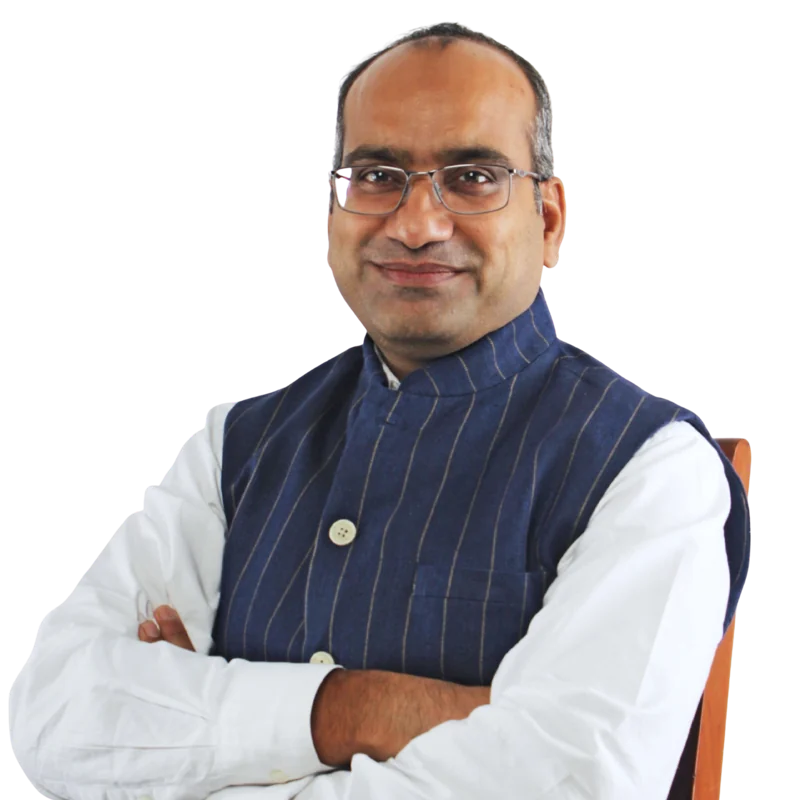
Sujeet Kumar
Rajya Sabha MP from Odisha, Parliament of India
“There has never been a better time to be an Indian.”
Full session video
Session recap
In the Day-2 valedictory address, Sujeet Kumar — Rajya Sabha MP from Odisha, Harvard- and Oxford-educated, MBA from Saïd Business School, and author of AI on Trial — opened with disarming candour: "As politicians, we get invited to dozens of events. I wasn't sure I could contribute anything to a faculty development programme. But I learnt myself a lot over the last two days." What followed was a deliberately structured take-home: five mega-trends — five D's — that will shape Bharat's journey to Vikasit Bharat 2047, and, more pointedly, the curriculum every B-school will need to design for the next generation of managers. Demography (a billion Indians under 35; ageing developed economies — Germany, Japan, Taiwan — actively recruiting Indian talent; the German Labour Minister's specific ask for "5,000 nurses and caregivers from India"). Digitization (700 million UPI transactions a day; 200 billion in 2025; 50% of global real-time transactions; 1.39 billion smartphone users; 6G rollout). Democracy (970 million registered voters in 2024; 700 million who actually voted; results in under 72 hours; India as the world's "first responder" per Brookings; the India–EU FTA being called "the Mother of All Deals"). Decarbonisation (net-zero by 2070; 500 GW of green energy by 2030 — "we'll do it by 2028"; private sector now bidding for Bharat Modular Reactors). And AI — the mother of all trends. His AI section cut harder than the rest. Drawing on AI on Trial, he walked the room through Shanghai's December-2024 incident of a senior robot organising 12 junior robots into industrial action; the Florida teenager's suicide after sustained interaction with character.ai (2023); a similar tragedy in Lucknow; and the open legal questions India must answer urgently — who is the "abetter" when AI prompts a suicide? Who owns the data that trains a model? Who owns its output? Should an AI model be granted juristic personhood? He laid out India's four-pillar Sovereign AI stack — data, skilling, infrastructure, regulation — and was unambiguous that regulation is the lagging pillar. He closed with two interventions that landed as concrete asks. First, "Make Geopolitics of Business a compulsory course" — every geopolitical shift now has a business angle, and managers will negotiate on a global stage. Second, "Interdisciplinary learning is the single most important skill the students of tomorrow will need" — connect demography to ageing economies, digitization to decarbonisation, AI to legal frameworks; the manager who can connect those dots is the one who will lead. And then the news. Sri Shreevats Jaipuria invited him to announce the headline outcome of their off-stage conversations: Jaipuria will be the academic partner to a newly-conceived Parliamentarian's Forum on Happiness, Well-being and Inner Peace, with launch targeted for the Indian Parliament's monsoon session from mid-June 2026 — a partnership designed to scale internationally to MPs in other countries.
Editorial summary compiled by the FDP team — not a verbatim transcript. Spotted an inaccuracy? Let us know.
Sujeet Kumar has been honoured with a tree at Trees for Tigers®, Sundarbans National Park, West Bengal, planted by Jaipuria Institute of Management as part of the 14th Annual FDP, 2026. Certificate No. 5533752, dated 10 May 2026. The plantation is geotagged and trackable via Grow-Trees.com — "these trees will provide flowers, fruits, fodder and fuel to living creatures and improve water catchment areas."
A tree planted in his name
A Bountiful Tree at Trees for Tigers, Sundarbans National Park
As a token of gratitude for Sujeet Kumar’s presence at the 14th Annual Faculty Development Programme, Jaipuria Institute of Management has planted a tree in his honour. This tree will provide flowers, fruits, fodder and fuel to living creatures and help improve water catchment areas in the Sundarbans tiger habitat.
- Planted on
- 10 May 2026
- Certificate №
- 5533752
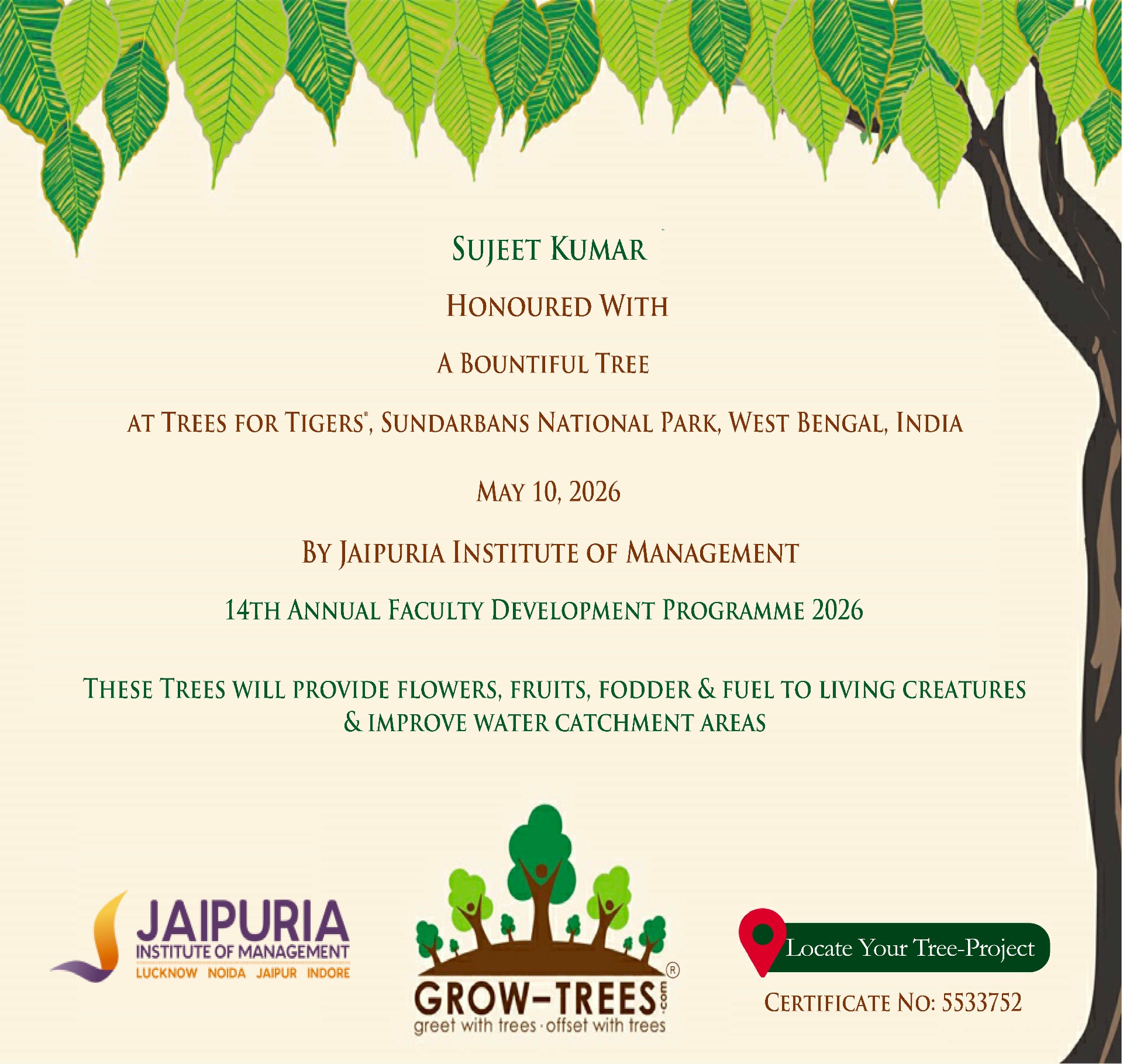
Geo-tagged green certificate · issued by Grow-Trees.com
Key takeaways for faculty
- 1
Add a compulsory course on the Geopolitics of Business
Every major industry decision now has a geopolitical lever — the Strait of Hormuz, the India–EU FTA, climate negotiations, talent migration corridors. Managers without this literacy will mis-read the next decade.
- 2
Make interdisciplinary learning the spine of the curriculum
The single most predictive skill for the AI-age manager is the ability to connect dots across the five D's — demography, digitization, democracy, decarbonisation, AI. Specialist depth without dot-connection is a redundant skill.
- 3
Embed sustainability and green economics across courses
Green bonds, green accounting, the Bharat Modular Reactors, the Pradhan Mantri Surya Ghar Bijli Yojana — these aren't electives any more. The ₹16-trillion-rupee capex into India's green energy space is creating entire new industries the curriculum hasn't named yet.
- 4
Plan curriculum for Indian talent going outbound
With Germany, Japan and Taiwan ageing rapidly and explicitly recruiting Indian talent, Jaipuria has a 20-year window to design programmes that prepare graduates for global posting — not just domestic placement.
- 5
Teach the legal and ethical framework around AI now — not later
Copyright on training data, output ownership, juristic personhood for AI models, abetment-to-suicide jurisprudence — these are unresolved questions whose first judicial precedents will shape the next decade. Future managers must understand them, even if lawyers haven't yet settled them.
- 6
Position the student in the middle of the AI hourglass
CEOs and manual workers are relatively safe; the bulk that gets hollowed out is the middle-skill office layer — paralegals, copywriters, accountants, designers. Susskind predicted this 23 years ago. Curriculum must prepare graduates for the complementarity premium (a 55–60% wage uplift for those who upskill alongside AI), not for the displaced middle.
- 7
Announcement: Parliamentarian's Forum on Happiness, Well-being & Inner Peace
Convened by Sujeet Kumar with Jaipuria as academic partner. Launch targeted for the monsoon session of the Indian Parliament, mid-June 2026 — designed to bring more Indian MPs into a structured well-being conversation, and to scale internationally to parliamentarians in other countries. The first formal academic-political partnership announced from the FDP stage.
Speaking at One Jaipuria FDP
- Five mega-trends shaping Vikasit Bharat 2047 — and the curriculum every B-school must build for them
- Demography (1st D) — a billion Indians under 35; the ageing-economy talent corridor across Germany, Japan, Taiwan; gender inclusion moving from 25% to 50% of workforce
- Digitization (2nd D) — 700 M UPI transactions a day; 50% of global real-time transactions; the 6G rollout; the R&D investment gap (India at 0.7% of GDP; corporate share <10% of all R&D vs. 70% in the US)
- Democracy (3rd D) — 970 M voters in 2024; India as global "first responder"; G20 Presidency taken to 400 locations; the India–EU FTA "Mother of All Deals"
- Decarbonisation (4th D) — net-zero by 2070; 500 GW green energy by 2030 (likely 2028); ~$2 trillion green capex underway; private sector entry into nuclear (Bharat Modular Reactors)
- AI (5th D) — cognitive machines; the Sovereign AI Stack (data · skilling · infrastructure · regulation); India's data-centre boom post-DPDP Act 2023; the legal and ethical frontier no jurisdiction has yet settled
- India's Sovereign AI Stack — Data (15% of all global data; DPDP Act mandates Indian data stays in India; still in silos), Skilling (~55 lakh IT pros, ~5 lakh AI/data pros; 10 lakh teachers being trained on AI literacy), Infrastructure (India AI Mission compute, GPUs, data centres, green power), Regulation (the most lagging pillar — no clarity on AI juristic personhood, training-data copyright or AI-output ownership)
- Open legal questions — abetter when AI prompts suicide (Florida character.ai, Lucknow case); NYT v. OpenAI and ANI v. Indian AI startups on training data; AI-output copyright; juristic personhood for AI; need for a new IP asset class for machine-created intellectual property
- Stories from the address — Shanghai (Dec 2024) factory robots' industrial action; Florida 2023 character.ai suicide; Lucknow AI-intimacy suicide; Jasmeet Kaur's boutique outside Tihar going viral via Deepika Padukone; Operation Dost (Turkey earthquake); Kalahandi G20 in his rural-tribal home district
- Two compulsory additions — Geopolitics of Business as a core course, and interdisciplinary learning as the spine of the curriculum
Q&A captured
Q. Who is the "abetter" when an AI model prompts a suicide? IPC 306 punishes only humans.
That is exactly the open question. Florida 2023 (character.ai) is sub judice in the US; the first Indian case is now in Lucknow. The first judicial precedents will shape Indian AI policy for the next decade — and will need a new framework, because IPC 306 in its current form was not drafted for non-human abetters.
Q. Who owns AI output — and the data used to train the model?
Training data: NYT v. OpenAI in the US; ANI v. Indian AI startups in India — both unresolved. Output: if a faculty member prompts ChatGPT to write a poem, can they claim copyright? India needs a new IP asset class — beyond copyright, trademark and patent — for machine-created intellectual property. Until that arrives, the law lags the technology by a decade.
Q. Should an AI model be granted juristic personhood?
Indian law already recognises juristic personhood for corporations and for deities. Whether to extend it to AI models is the harder, more interesting question — and the one regulators worldwide are now circling. India has the chance to lead this conversation, not follow it.
Q. What's the single most important skill the students of tomorrow will need?
Interdisciplinary learning. Connect demography to ageing economies, digitization to decarbonisation, AI to legal frameworks. The manager who can connect those dots is the one who will lead. Specialist depth without dot-connection is a redundant skill in the AI age.