
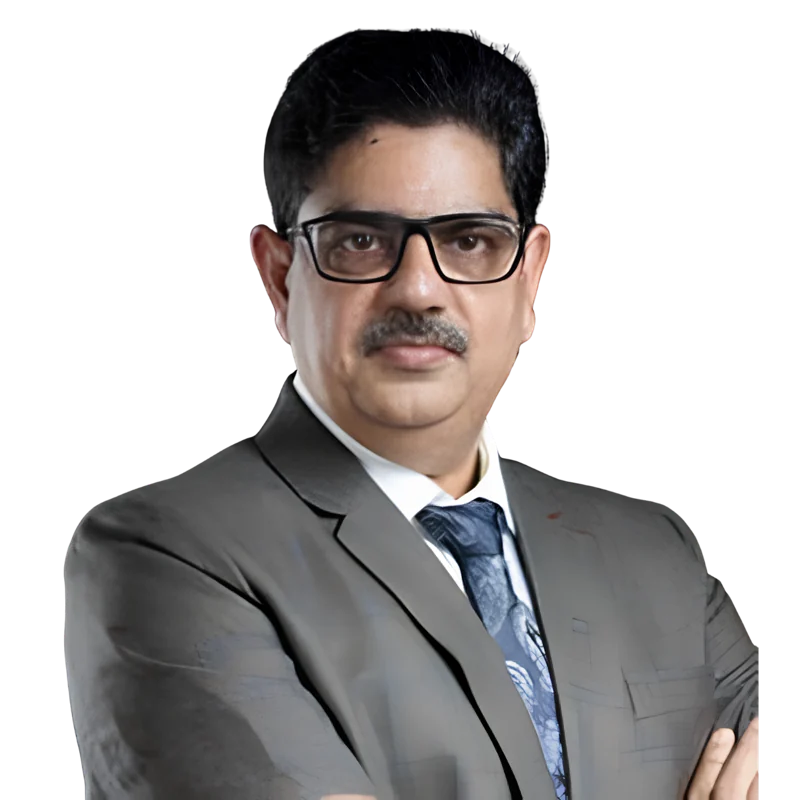
Prof. Alok Kumar Rai
Director, IIM Calcutta
“We are not publication machines.”
Full session video
Session recap
Prof. Alok Kumar Rai, Director of IIM Calcutta and Chief Guest of the FDP, structured his address into three deliberate parts: ten minutes for the faculty fraternity, ten on what IIM Calcutta is doing with AI, and ten for Q&A. To the fraternity, he made a sharp distinction: the difference between a faculty member at a "not-so-great institution" and one at IIM Calcutta is creation — the ability to unfurl student potential rather than reproduce content. Drawing on a span that has taken him through a self-financed institution, BHU, Lucknow University (as VC), Agra's affiliating university, a Sanskrit university, IIM Calcutta and most recently a deemed university in Port Blair, he argued that research today is one of the most abused words in academia: "we get a project, obtain a utilisation certificate, claim it as research, publish it — and never ask what the society actually got out of it." That gap, he said, is what lasting research must close. He turned next to AI at IIM Calcutta — currently being used in academics, evaluation (with three tools, two procured and one in-house, where benefit of doubt always goes to the student), and a new system that records a faculty member's voice, face and modulation for five minutes and delivers a 90-minute lecture in their style across multiple batches. His framing: "see AI just as an IT tool — there to support decision-making, faster, swifter and more accurate. Don't get bogged down with AI. Quantum computing is coming." He closed Q&A with two pieces of practical counsel: the key to good publication is patience with literature review (now made easier by AI-powered paper summarisation), and the key to leadership is not vision — vision can be outsourced — "the key lies in your ability to build a team that delivers what you have envisioned."
Editorial summary compiled by the FDP team — not a verbatim transcript. Spotted an inaccuracy? Let us know.
A tree has been planted in Prof. Rai's name in the Sundarbans as part of Jaipuria's green-certificate initiative. The plantation is geotagged and trackable — certificate emailed.
A tree planted in his name
A Bountiful Tree at Trees for Tigers, Sundarbans National Park
As a token of gratitude for Prof. Alok Kumar Rai’s presence at the 14th Annual Faculty Development Programme, Jaipuria Institute of Management has planted a tree in his honour. This tree will provide flowers, fruits, fodder and fuel to living creatures and help improve water catchment areas in the Sundarbans tiger habitat.
- Planted on
- 9 May 2026
- Certificate №
- 5533716
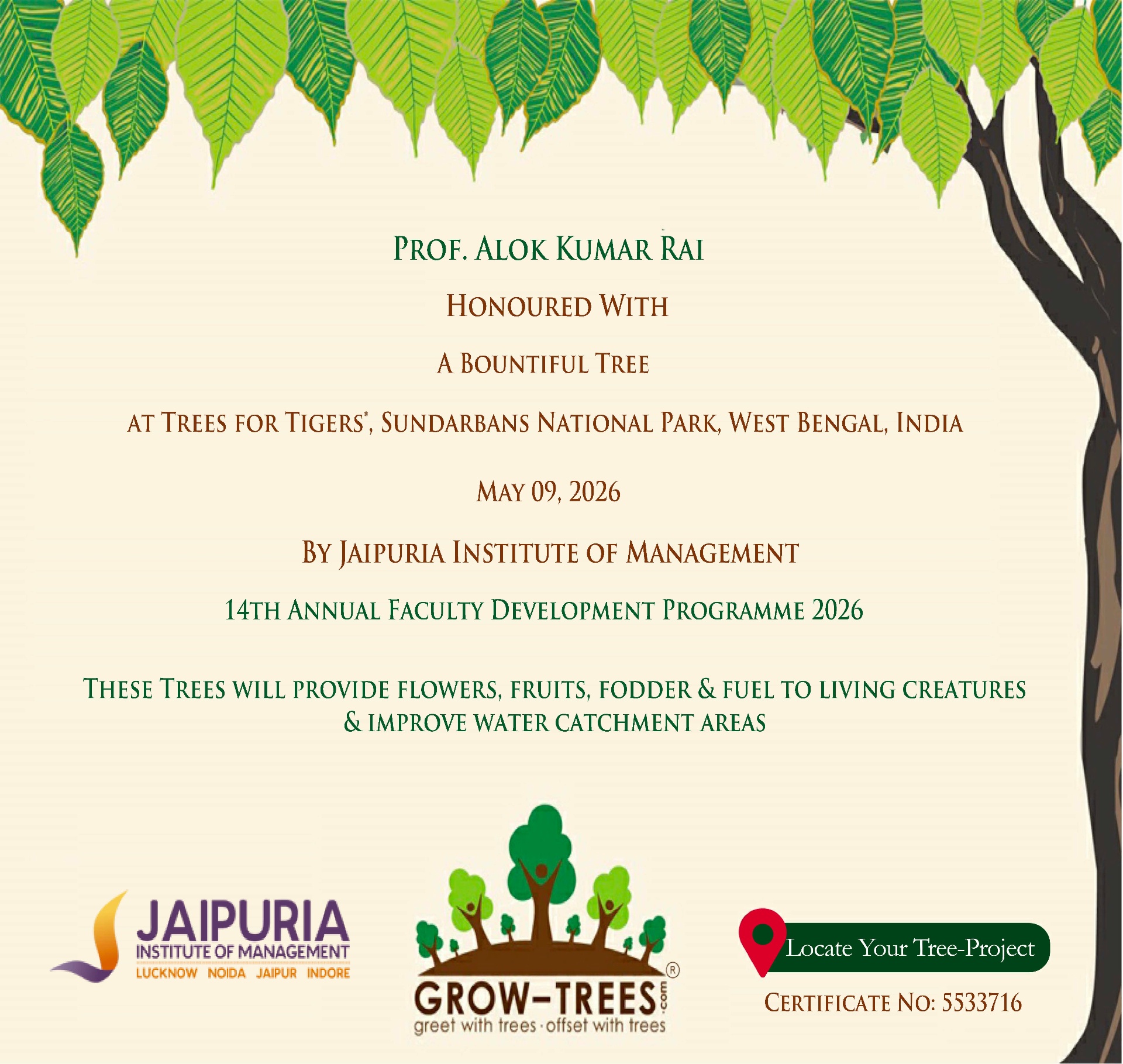
Geo-tagged green certificate · issued by Grow-Trees.com
Key takeaways for faculty
- 1
Move from technique-based to concept-based research
Most published management research is statistically mechanical — give me any survey paper and I will challenge its data. The lasting work is conceptually fundamental and starts with a sound problem framework, not a sophisticated method.
- 2
Tie every research project to a societal outcome
"What did the society get out of this study?" If you cannot answer that question for a project, the publication is incidental, not foundational.
- 3
Refuse the publication-machine identity
Publication matters for AACSB, NIRF and EQUIS — but it cannot become the metric that crowds out the teacher in you.
- 4
Treat AI as an IT tool, not a discipline
Don't repeat the MBA-in-Insurance / MBA-in-Telecom mistake by building entire programs around it. The current AI age will not outlast five years; quantum is already at the door.
- 5
Build the team before the vision
Vision is fashionable but largely outsourceable. What no consultant can give you is a team capable of executing it. Individuals matter — they take organisations from Arsh to Farsh, or back.
Speaking at One Jaipuria FDP
- What separates a great faculty from a competent one: creation vs. reproduction
- Why research must have a societal outcome, not just a publication
- The publication-driven appraisal problem at AACSB / NIRF / EQUIS-graded institutions
- AI-powered evaluation at IIM Calcutta — three-tool architecture, benefit of doubt to the student
- AI-replicas of faculty: voice, expression and modulation captured in 5 minutes, delivering 90-minute lectures across batches
- Leadership: building the team is more important than crafting the vision
Q&A captured
Q. For an early-career faculty who doesn't want to play the publication game but wants to do meaningful research — what would you suggest?
The key lies in literature review — the part everyone finds most boring. Have patience in the early years. The sounder your problem framework, the better your publication. AI-powered paper summarisation tools now make this far less painful than it was even five years ago.
Q. How do you judge whether a research paper is good or bad?
Look at data consistency — there is software for this now. And look at questionnaire design: the use of double-barrelled questions, negative-keyed questions, and built-in cross-checks separates serious work from response-pattern fishing.
Q. What are the essentials of leadership?
The textbook says functional skill at the bottom, human skill in the middle, conceptual skill at the top — I disagree slightly. Vision is largely outsourceable; consultants will give you one. What no-one can give you is a team that delivers it. Build the team. Individuals matter.