

Dr. Mayank Dhaundiyal
Professor & Dean, Jindal Global Business School, OP Jindal Global University
“The sage on a stage is obsolete. People can learn Bloom's Taxonomy from a chatbot much better than from many of us.”
Full session video
Session recap
On Day-2 morning, three sitting heads of institutions — Dr. Raj Singh (Vice Chancellor, Bennett University), Dr. Vishal Talwar (Chief Operating Officer, University of Southampton, Delhi) and Dr. Mayank Dhaundiyal (Dean, Jindal Global Business School) — sat down with Dr. Daneshwar Sharma for a frank 75-minute conversation on what is no longer working in B-school teaching and learning. The closing line of the moderator captured it: "the title itself has to change — it's no longer Teaching & Learning, it's Learning & Teaching." Raj Singh opened by citing two 2025 publications — Stephen Means' October piece on AI making higher education "sleepwalk" and the January report from a nine-dean Harvard Business School committee. Both arrived at the same uncomfortable verdict: the credential is no longer believed by industry because grades no longer reflect what the student actually knows. His prescription was structural: theory will move to online, the classroom must become the place where new perspectives are developed, and the third leg — students working with industry, community and society — is the part Indian B-schools have not yet built. He offered a live proof-of-concept from Bennett: an entrepreneurship boot camp every dean refused to release students for ran from 6 PM to 8:30 AM the next morning, students refusing to leave the classroom even for the mid-term test the following day. Mayank Dhaundiyal was the operator's voice. Two things, he said, are broken. First, the 75-to-90-minute "content delivery" class is obsolete — content was commoditised by Google a decade ago, and AI has now made it digestible. The "sage on a stage" model loses to ChatGPT on understanding Bloom's Taxonomy or Porter's Five Forces. Second, the research-teaching disconnect: faculty publishing in FT-50 A-stars are not channelling that new knowledge into the classroom, and "no one even knows who is reading those papers." His Jindal answer: every core course (≈30 sessions) has 4–5 mandated Experiential Learning Sessions — no PPTs, tools-based, hands-on, often co-delivered with an industry practitioner. Vishal Talwar reframed the question entirely: are B-schools competing with each other, or competing for relevance? The fabric of a 40–80-year-old institution will not pivot in time, and some of what we do will simply disappear regardless. Three structural problems, in his diagnosis: faculty-centric models built for our own convenience; deep silos of marketing/finance/strategy that an AI-first economy will not respect; and curriculum approval cycles that take three to five years when the half-life of relevance is now six months. His sharpest data point came from his own analytics: students who average 25–30% attendance in normal classes stayed in a Southampton social-impact boot camp from morning till 1 AM across a weekend. The students aren't disengaged — the format is. Three closing convergences from the panel: (1) attendance can no longer be enforced — UGC/AICTE 2025 regulations now make it illegal to bar students from exams over attendance, so the only lever left is making the class worth attending; (2) the appraisal system must reward research with classroom impact, not citation count alone; and (3) faculty themselves need mentoring, training and the institutional time to be "AI-first" rather than "AI-anxious" — an AI-anxious faculty cannot teach an AI-native student. The session closed with the moderator's reframing: Learning & Teaching, in that order.
Editorial summary compiled by the FDP team — not a verbatim transcript. Spotted an inaccuracy? Let us know.
Honoured with a tree at Trees for Tigers®, Sundarbans National Park, West Bengal, planted by Jaipuria Institute of Management on 10 May 2026. Certificate No. 5533760, as part of the 14th Annual FDP, 2026. The plantation is geotagged and trackable via Grow-Trees.com — "these trees will provide flowers, fruits, fodder and fuel to living creatures and improve water catchment areas."
A tree planted in his name
A Bountiful Tree at Trees for Tigers, Sundarbans National Park
As a token of gratitude for Dr. Mayank Dhaundiyal’s presence at the 14th Annual Faculty Development Programme, Jaipuria Institute of Management has planted a tree in his honour. This tree will provide flowers, fruits, fodder and fuel to living creatures and help improve water catchment areas in the Sundarbans tiger habitat.
- Planted on
- 10 May 2026
- Certificate №
- 5533760
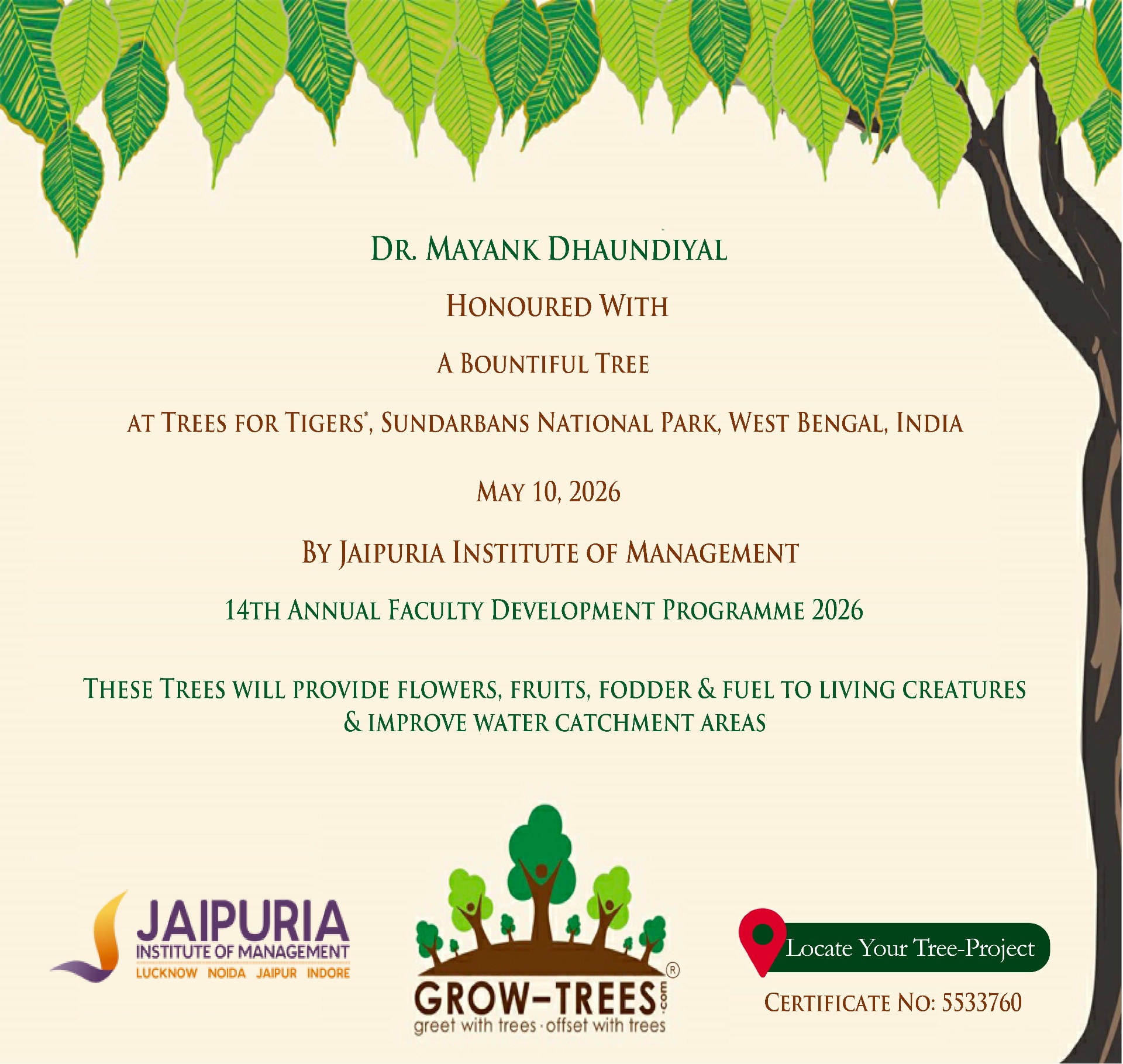
Geo-tagged green certificate · issued by Grow-Trees.com
Key takeaways for faculty
- 1
Move teaching out of the classroom in three layers
Theory → online (best professor in the world per topic, not one professor for 50 hours). Classroom → develop new perspectives (cases, debates, peer challenge). Out of campus → working with industry, community and society. Indian B-schools have built the first two and still owe the third.
- 2
Content delivery in a 90-minute lecture is obsolete
Content was commoditised by Google a decade ago; AI has now made it digestible step-by-step. The faculty role has to shift from delivery to facilitation, sense-making and orchestration of experience.
- 3
Mandate experiential sessions inside every core course
Jindal's rule: of ~30 sessions per core course, 4–5 are Experiential Learning Sessions — no PPTs, tools-based, often co-delivered with industry practitioners running a live brief (Canva, AI tools, real campaigns).
- 4
Attendance cannot be the lever any more — interest is
UGC/AICTE 2025 regulations make it illegal to bar students from exams over attendance. The only lever left is making the class worth attending. Bennett's entrepreneurship boot camp ran from 6 PM to 8:30 AM with no attendance rule. Southampton's boot camp held 25%-attendance students till 1 AM.
- 5
Close the research-teaching gap, not just the citation count
Publishing in FT-50 A-stars without channelling that new knowledge back into the classroom is the gap. Move appraisal from "how many papers" to "what is the documented classroom and societal impact" — the UK's REF model is one reference point.
- 6
Break the silos before AI breaks them for us
Marketing-finance-strategy divisions are deep but won't survive an AI-first economy. Curriculum approval cycles must compress from 3–5 years to 6 months. Bring in climate science, AI governance and sustainability faculty to engineer the core, not just add elective courses.
- 7
Teach sense-making — it doesn't appear on any syllabus
Critical thinking and analytical skills are named in every brochure; sense-making is named in none. How a student ascribes meaning to noisy data, to a table in front of them, to the macro environment — there is no structured course for this anywhere.
- 8
Faculty themselves need mentoring, training and time
An AI-anxious faculty cannot teach an AI-native student. The investment is real (high-compute models, partnerships, time freed from admin) and the leadership grasp of the technology is still nascent at most institutions — that is the gap to close first.
Speaking at One Jaipuria FDP
- What is no longer working in B-school classrooms — across IIMs, IoE deemed universities and international campuses
- The Harvard Business School 2025 dean-committee report and Stephen Means' AI-sleepwalk thesis
- Three-layer teaching model: online theory → in-classroom perspectives → out-of-campus industry/community work
- Why content delivery in a 75–90-minute class is obsolete and what replaces it
- Experiential Learning Sessions baked into every core course — Jindal's operating model
- Bennett's entrepreneurship boot camp: 6 PM to 8:30 AM, students refusing to leave even for the mid-term
- Attendance regulations 2025 — students can no longer be barred from exams; interest is the only lever
- Curriculum approval cycle compression: 3–5 years → 6 months for an AI-first economy
- The research-impact problem: publication count vs. documented classroom and societal impact (UK REF model)
- AI-anxious faculty vs. AI-native students — what mentoring, training and investment closing the gap looks like
- Sense-making as the un-taught core skill — beyond bar charts and pie diagrams
- Why the title needs to flip from Teaching & Learning to Learning & Teaching
Q&A captured
Q. What is stopping us from moving towards research impact orientation — faculty, ecosystem, accreditation, or the fact that education is no longer a merit good? (Faculty Q)
Raj Singh: It's the ecosystem — top management, operational leadership and faculty. Nothing is technically stopping us; we just don't have the tools to implement the ideas, six years post-NEP. The mindset has to change first. Vishal Talwar: We are still counting publications, not impact. The UK's Research Assessment Exercise (REF) framework requires institutions to submit specific impact cases — government budgets are tied to it. Until our appraisal moves from numbers to documented impact, nothing shifts.
Q. Faculty engage students, but how do we stop "engagement" from becoming "entertainment"? (Moderator)
Raj Singh: Entertainment should be a part of engagement — only then will students engage. Forcing attendance is to some extent unethical; if they don't like attending, you cannot force them. The first transition has to be from a teaching paradigm to a learning paradigm — teaching pushes them, learning attracts them.
Q. Gen Z and Gen Alpha consume 6–7 hours of social media per day. Is reframing T&L enough, or do we need deeper reforms? (Faculty Q — Dr. Ankur)
Mayank Dhaundiyal: The audience is in a different zone — they switch off in 2–3 minutes if it's repetitive. The moment you open slides, they're done. Curriculum is largely fine; pedagogy is the problem. The answer is experiential — simulations, classroom exercises, industry practitioners running live campaigns on Canva or AI tools. Asynchronous, location-independent learning is what students now expect, and we missed the EdTech-driven engagement learnings post-COVID.
Q. If a teacher is good, attendance takes care of itself — students stand on stairs to attend H. C. Verma or Kalyanmoy Deb. So is the fix just better teachers? (Faculty Q — Dr. Ajay Jha, Lucknow)
Panel consensus: Yes, partly — and that's exactly why the lever has shifted from compelling attendance to compelling interest. Raj Singh's data point: at his university, when 12,000 students were asked what made them attend more, the answer was "more engaging activities, instant marks in practical sessions, things we actually learn." The Verma/Deb effect scales when the pedagogy and the ecosystem are designed for it, not when one heroic faculty member compensates for a broken system.
Q. How do you define student engagement, and what is the role of faculty in this new ecosystem? (Moderator)
Vishal Talwar: It's already very clear — the writing is on the wall. We need to teach AI-enabled business models, AI governance, human-machine coexistence — not as an elective, but engineered into the core. Faculty need to work across the silos of marketing/finance/strategy on real problem-solving, not in isolation. The curriculum has to train students to judge better, answer messy questions, and influence — that is what placement-driven, race-to-the-finish models are not delivering.